Meta Ads vs Google Ads: Which Is Better for Your Business?
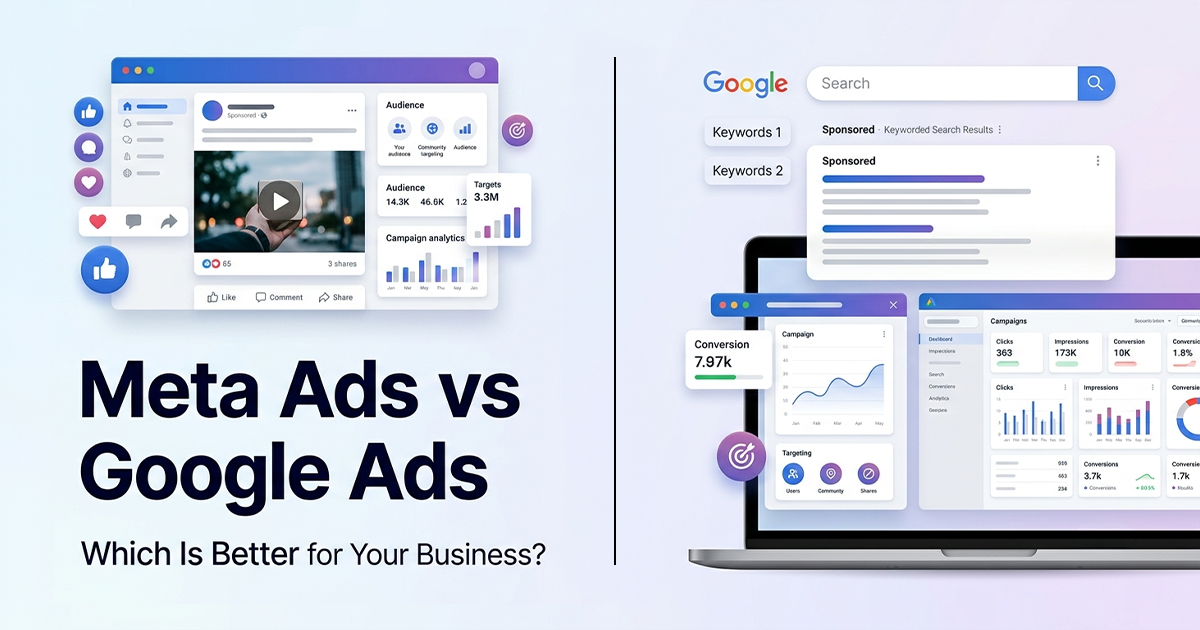
Ask ten business owners where they should spend their advertising budget and you will hear two answers again and again: "Run Instagram ads" and "Just put it on Google." Both answers are fair, and that is exactly why the decision feels so hard.
Meta Ads and Google Ads are the two platforms most small and mid-sized businesses start with. They work in very different ways, so the better choice depends on what you sell, who buys it, and what you want your ads to achieve. This guide walks through how each one works, where each performs best, and how to pick the right starting point.
What are Meta Ads and Google Ads?
How Meta Ads work
Meta Ads is the system behind advertising on Facebook and Instagram. You build an ad, choose your audience by location, age, interests and behaviour, and Meta shows it in feeds, Stories and Reels.
The people who see your ad were not looking for you. They were scrolling, and your ad turned up in front of them. That makes your creative the most important part. A photo or video has to earn attention in a second or two, or it gets scrolled past.
How Google Ads work
Google Ads puts your business in front of people who are already searching. When someone types "dentist in Kozhikode" or "wedding photographer near me," your ad can appear above the regular results. You pick the keywords you want to appear for, and you pay when someone clicks.
Google Ads also covers YouTube, Display banners and Shopping ads, but Search is where most small businesses begin.
Creating demand vs capturing demand
This one idea makes the whole comparison easier.
Google captures demand that already exists. The person searching has a need and is ready to act, so your ad meets them at the right moment.
Meta creates demand. It introduces your business to people who had not thought about you yet. A new café, a clothing launch, an event, a course: Meta is very good at making people notice these things and want them.
Neither approach is better in general. They answer different questions, and the right one depends on where your customers are in their decision.
Meta Ads vs Google Ads at a glance
| Meta Ads | Google Ads | |
| Where ads appear | Facebook, Instagram | Google Search, YouTube, Display, Shopping |
| Who sees them | People matching your audience profile | People searching for related keywords |
| Buyer intent | Lower; people are browsing | Higher, people are searching. |
| Strength | Awareness, visuals, storytelling | Leads and sales from ready buyers |
| Creative needs | High (strong images and video) | Lower for search (text ads), higher for YouTube and display |
| Best for | Products, events, launches, local brands | Services, urgent needs, specific searches |
| Speed of results | Quick reach, slower to convert | Often quicker enquiries, if people are searching |
Where Meta Ads work better
Meta is usually the stronger choice when your business is visual or when people need an introduction before they buy.
- Restaurants, cafés and food brands. A good video of your food does more than a text ad ever could.
- Fashion, jewellery, home décor and lifestyle products. People often buy these after seeing them, not after searching for them.
- New launches and events. If nobody knows your brand yet, nobody is searching for it.
- Local awareness. You can target people within a set distance of your shop or showroom.
- Retargeting. You can show ads to people who already visited your website or engaged with your page.
Where Google Ads work better
Google is usually better when people already know what they need and are looking for someone to provide it.
- Clinics, hospitals and dental practices. Someone with a toothache searches. They do not wait to be inspired by an ad.
- Repair, installation and home services. The need is urgent and the search is specific.
- Education and training. Students and parents research before they enquire.
- Legal, financial and professional services. People look for credible providers and compare them.
- B2B services. Decision-makers search for suppliers and solutions.
A simple test: if a customer would reasonably type your service into Google, Google Ads should be part of your plan.
Should you go for both?
For many businesses, yes, though not always on day one.
The two platforms support each other well. Someone sees your Instagram ad, remembers your name, and a week later searches for you on Google. If you only run Google Ads, you reach people who already want what you offer. Add Meta and you also reach the people who will want it next month.
If your budget is small, start with one platform and run it properly. Splitting a limited budget across two platforms often leaves neither with enough to perform. Start where your customer is most likely to be right now. If they are searching, begin with Google. If they need an introduction, begin with Meta.
How much should you spend?
There is no single right number. Costs depend on your industry, location, competition, the quality of your ads, and how well your website turns visitors into enquiries. Google keywords can cost very different amounts for a niche service and a competitive one, and Meta costs shift with audience size, season and creative quality.
What matters more than the amount is being able to sustain it long enough to learn something. Running ads for three days and judging the results tells you very little. Most campaigns need time to collect data and be adjusted, so choose a budget you can keep up for several weeks, then review what the numbers show.
Common mistakes businesses make
- Boosting posts without a goal. The Boost button is quick, but it is not a strategy. Decide first whether you want enquiries, website visits, followers or sales.
- Using broad keywords on Google. A very general keyword brings clicks from people who were never going to buy.
- Not tracking conversions. If you cannot see which ads lead to calls, form fills or purchases, you are guessing.
- Sending traffic to a weak page. A slow, confusing or poorly built mobile page wastes good ads.
- Judging too early. Give campaigns enough time and data before changing everything.
- Ignoring creative. On Meta especially, tired or low-quality visuals will hold results back, however well the targeting is set up.
A quick checklist to help you decide
- Are people already searching for what I offer? If yes, lean towards Google.
- Is my product or service visual and easy to show? If yes, Meta is a good fit.
- Is my brand new or little known? Meta can build awareness.
- Do I need enquiries soon? Google Search often delivers faster when demand exists.
- Do I have good photos or video? If not, sort this out before spending on Meta.
- Is my website ready to convert visitors? If not, improve it before spending on either platform.
If your answers point in both directions, run a small test on each and let the results guide your next step.
Frequently asked questions
Is Google Ads better than Facebook Ads?
Neither is better for every business. Google Ads suit businesses whose customers search for a specific service. Facebook and Instagram ads suit businesses that need to build awareness and show their product.
Which is cheaper, Meta Ads or Google Ads?
It depends on your industry, competition and targeting. Meta clicks are often cheaper, while Google clicks can cost more but come from people with stronger intent. Compare the cost per enquiry or sale, not just the cost per click.
Can a small business use both?
Yes. Many do, once the budget is big enough to run each properly. With a small budget, start with one platform and add the other later.
Are Instagram ads part of Meta Ads?
Yes. Meta runs advertising across Facebook and Instagram, and you manage both from one ad account.
How long does it take to see results?
Google Search can bring enquiries within days if people are actively searching. Meta campaigns usually need a few weeks to learn and improve. Both get better with testing and adjustment.
Do I need a website to run these ads?
Not strictly. Meta lets you send people to a profile or a WhatsApp chat. Even so, a good website or landing page generally improves results on both platforms.
Not sure which one is right for you?
The right mix of platforms depends on your business, your customers and your goals. If you would like a second opinion before you spend, the La Creatives team can look at your situation and suggest a practical starting point. Visit our contact page to start the conversation.